|
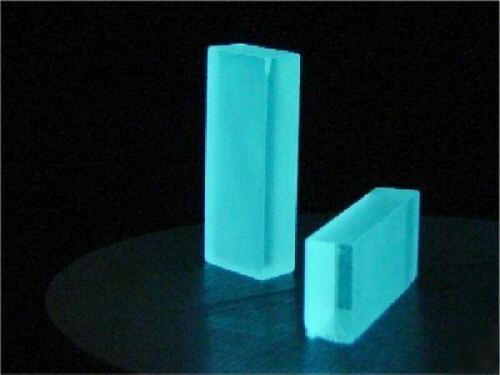
All crystals I offer are clean and in very good condition with no large chips. The polished end faces do have some minor flaking or roughness on the edges and corners but this commonly occurs during manufacturing and should not have any measurable effect on performance. $7.96 or internationally for $9.96USD" This is what the crystals look like when exposed to an X-ray beam. Below is some information on the properties and specifications of BGO: Bismuth Germanate, also called BGO, is a high density scintillation material. Due to the high atomic number of bismuth (83) and its high density, BGO is a very efficient -ray absorber. Because of its high effective Z value, the photofraction for -ray absorption is high, which results in a very good photo-peak to Compton ratio. The scintillation light can be detected with standard photomultiplier tubes. The scintillation intensity of Bismuth Germanate is a strong function of the temperature. The decay time of BGO is about 300 ns at room temperature, which is comparable to that of NaI(Tl). However, the afterglow is much lower, typically about 0.005% after 3 ms. BGO is relatively hard, rugged, non-hygroscopic crystal which does not cleave. The material does not show any significant self absorption of the scintillation light. The crystal housing can be kept simple since no hermetic air-tight sealing is required. BGO can be machined to various shapes and geometries. BGO scintillation crystals are used in applications where a high photofraction is required (as in PET scanners) or because of its high density (as in Compton suppression spectrometers). Wavelength of emission maximum; 480 nm Lower wavelength cutoff; 320 nm Refractive index at emission maximum; 2.15 Afterglow (after 3ms); 0.005 % Light yield; 8 - 10 x 103 photons/MeV (please look at our rules and privacy policy) |
nnewton@modularparts.com (Norman Newton) for more information. This email will be sent to Norman Newton' actual email address.